
The next morning I woke from restless sleep, into feverish incredulity, as the cold clutch of fear in my chest widened, in sync with my eyelids. Still skirmishing around denial, I questioned the validity of yesterday’s events:
‘Did the consultant actually say Alzheimer’s?’
‘Surely that can’t be right?’
‘He can’t have Dementia.’
‘No; not my lovely Ray.’
‘Perhaps it was just a bad dream?’
For a few wonderfully light seconds, I toyed with the dream idea. Could It be, it was all just a nightmare we’d awaken ourselves out of, Ray and I; that everything was still alright and we were whole again?
There was a nanosecond of exquisite relief, quickly followed by an icy clutch in my chest as dreadful re-acquaintance with that which I had no desire to meet in the first place hit me, all over again.
Yes, it’s Alzheimer’s.
In the days following diagnosis, I’m sure some people question if it’s the right conclusion; they may even ask for a second opinion. I didn’t. I had been there for the agonising, ordeal-by-mystification of cognition-testing. Though I hated the thought of Alzheimer’s, with a vengeance bordering on lethal, I couldn’t deny the signs.
For the uninitiated, cognitive-testing, for dementia, is a bit like a low-level IQ test. It entails a series of questions, diagrams, and memory tests. In Ray’s case, it constituted around an hour and a half of ever diminishing correct answers.
‘Which word is the odd one out?
(Pass)
‘Join the dots for this drawing.’
(Drawing?)
‘What number comes next in the series?’
(He tried, bless him, but ran out of wrong guesses)
‘Draw a line between matching symbols.’
(Hmmmm?)
‘Can you draw the hands on the clock-face drawing, so the time reads five-o-clock?’
(No, he couldn’t)
‘Put the animals in their correct groups’
And so on…
Words cannot adequately convey how demoralising it is, for both the person being tested and family members, seeing a loved one struggle with tasks they would have sailed through in infant school. The long, drawn-out fragmentation of my bright, articulate, Sudoku, Word-search and crossword- puzzle loving husband was almost too much to bear. Pinching far harder, than that particular torment though, was my ominous estimation of how Ray must feel. There is no hiding place, where the marathon of mental-competence (or lack thereof) testing is concerned. The signs you might have been able to brush over at home, to compensate for even, are suddenly glaringly obvious.
I had stood as reluctant witness to the adjudication of Ray’s scoring. I’d even offered mitigation in his defence:
‘ His hearing’s deteriorated lately,’
‘I’m not sure, he heard all the questions.’
‘I think he might have misinterpreted that one.’
‘I know it’s not the right answer but I can actually follow his logic with that one.’
But the stark reality of his floundering attempts to complete even the simplest of tasks was still painfully clear. The things I didn’t want to register in every day life, the reduced ability I instinctively adapted around was one thing; testing was quite another.
I really had to fight the urge to help Ray out, with gentle prompts (hence why they sit you behind the testee, the instinct to try and ‘help’ is almost irresistible)
As the failures totted up, I was repeatedly stung by Ray’s lack of basic ability. I was at least thankful he couldn’t see my evident distress, from my position behind him. He wouldn’t have seen the tears defying my attempts to wipe them away. Looking up at me, the consultant saw them though. I couldn’t quite read his expression, was it pity, or silent affirmation?
I was so sorry for Ray, particularly when he couldn’t read the time on a clock-face drawing; a common, early feature of Alzheimer’s apparently, I wanted to put my arms around him and shepherd him away from the showdown.
Desperately trying to suppress the urge, I grabbed handful after handful of tissues, attempting to soak up tears before Ray saw them. Listening to him trying but failing to spell or recognize words a five-year-old would have known, I knew we were in trouble. Even before Ray called surrender on the process, i realised the writing was on the wall; we just hadn’t had a name spelt out yet.
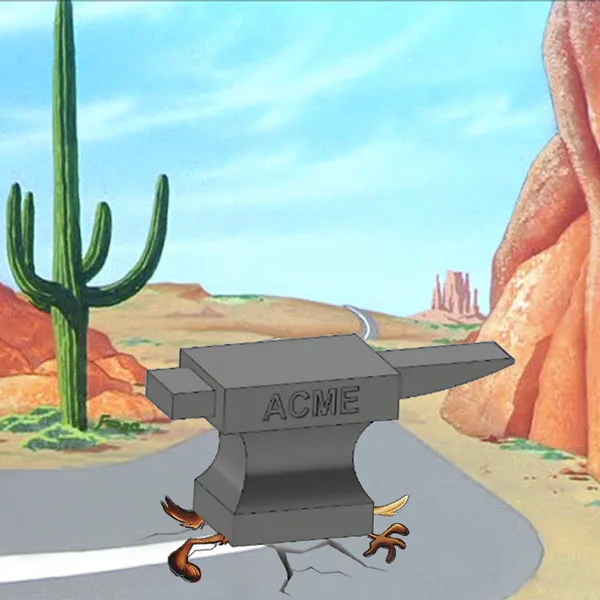
As reality settled in, that first morning after diagnosis, I felt I could hear the whistling descent of an anvil as it dropped towards me, like Wily Coyote, from the Roadrunner, Loony Tunes cartoons. I felt the earth-shaking whack of its landing too, as the nefarious missile hit, flattening any wistful resistance, I tried to muster.
As the clenching in my chest reached nauseating ferocity, it brought with it a molten throbbing in my ears, that spread across my head and neck. It wasn’t just my mind that remembered our unwelcome introduction to the ‘A’ word, my body did too.
With Ray still sleeping, l was alone with my reckoning. A sentinel on punishment duty, in self-imposed solitary-confinement for lack of vigilance, where letting the enemy in was concerned. Oh how I wished I could just switch-off and escape the coming day. I longed to roll-over and go back to sleep but, despite my exhaustion, rampant fear was keeping my eyes wide-open.
I knew I should haul myself out of bed but I really didn’t want to. Once my feet touched the floor, our new Alzheimer’s dawn would begin and I wasn’t ready for it. I wasn’t sure, I ever would be.
Pinioned to the bed by fearful apathy, I felt absolutely no impetus to make breakfast, get in the shower or even get myself a cup of coffee. I knew I would eventually have to but, in that miserable moment, the longer I avoided starting the day, the wider the stretch between yesterday and today became. Perhaps I could sink into the crevice between them?
In the facing-up-to-a-shitty-day league tables, getting out of bed earns a bronze, getting bathed and dressed nets a silver and doing just about anything else is a gold. So, eventually, I went for gold, hoping the pounding of my heart and taunting imagery would lessen as the day went on.
Propelling myself downstairs, to make coffee, my mind raced through a catalogue of memories. Like one of those books you flick quickly through until they form animations, except there was no amusement to be felt that day. The happier the memories, the more unhappy I felt. The contrast between them and the Alzheimer’s caricatures I was trying, unsuccessfully, to push aside, was too painful.
Stoically trying to maintain an upright position, I chattered around matters of little consequence, while the weight of grievous inevitability filled my head. For every shady thought I pushed away, something else would inflict a killer punch, downing me with a ton of dreadful sorrows.
Who we were, who we could have been, where we should be; Alzheimer’s had changed all of that. And what it didn’t erase it would distort. Overnight our destination had inexplicably altered. And, like it or not, we were on course to an entirely different future; one I daren’t even hold my head up to look at.
This and so much more was the tonnage I was trying not to swallow, as dementia dawned and, worse still, it was a secluded agony I couldn’t talk to Ray about.
With Ray’s diagnosis, the unwitting subject of my angst, how could I seek solace from him, when what assailed us, bit deeper into him than it did me? He must have had plenty of thought wrestling of his own to contend with, he didn’t need to dress my wounds too.
So, I ignored the Alzheimer’s elephant in the room. With the radio tuned in to bouncy music, I made breakfast; another meal digested without appreciation of the ingredients. I feigned interest in news articles that had seemed momentous yesterday. I parodied banter with Ray, over breakfast. I attempted to set out distraction markers in the day that stretched ahead of us, with propositions of jaunty trips out.
‘We could take the dogs out, before lunch?’
‘We need to get some bits of shopping too..
‘If we stop at the supermarket on the bypass, we could maybe have lunch out?
‘Ok.’ Said Ray, as easy-going as ever.
For every ‘nice’ thought though, a contrasting dreadful one snapped at its heels. Another chill thought suddenly struck me:
‘Will that change too, Ray’s affable demeanour?’
‘Will he change towards me, not recognise me one day?’
Another stab of thought, I didn’t carve out for Ray. Rising from my chair, I hastily wiped away desolate tears.
‘Lets go out somewhere, anywhere.’ I said, parking the breakfast things in the sink.
Though I wouldn’t realise it, until later, I was only just beginning to notice one of the first fouls from Alzheimer’s. Namely, the gradual loss not just of my husband but also of my confidante, my friend, my shoulder to lean on.
We still spoke to each other, of course we did, but neither of us pointed towards the elephant.
Mindful of the quandary Ray must be in, had he wanted to talk about it, I would absolutely have done so but I wasn’t going to drag him towards doing so that day. Suddenly though, much of what consumed my thoughts felt like it was off-limits, where Ray was concerned.
The biggest crisis of our lives and I couldn’t approach the one person I would normally take everything to: my Ray. How could I, when, every fear, anxiety, query and conclusion risked wounding him more than me?
So, I battened down the hatches on much of what quaked my thoughts, that morning. I bolstered my, ‘We’ll be ok’ demeanour with fluffed up chat. I attempted to avert our attention, with breezy trips to the park and sipped coffee in cafes, full of happy-families I felt disjointed from.
As I did so, somewhere on the ground Ray and I stood upon, Alzheimer’s was chalking out a line, between the two of us. A division it would eventually score out in permanent ink, before widening the distance between us. I hadn’t seen the line yet, but I knew it wouldn’t be long before I did